

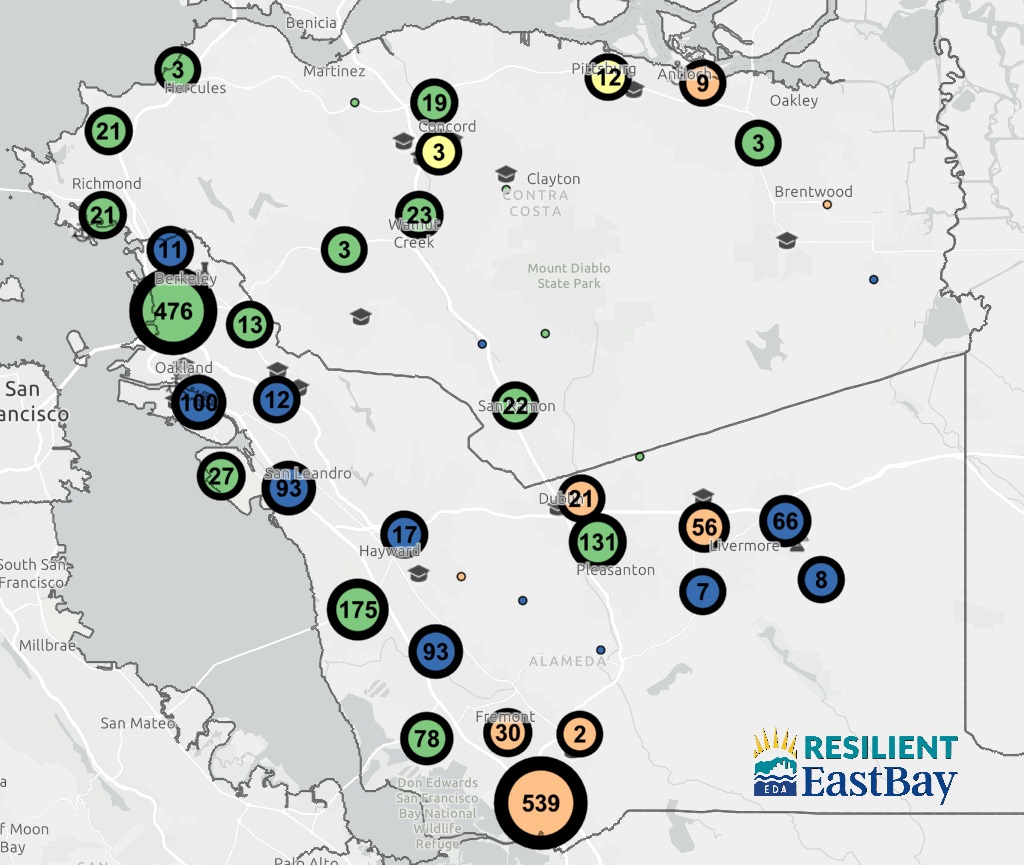
Is a surgical robotics company in the biomedical industry, or maybe the electronics or engineering/machining industries, or even the software industry? Is a drug maker a chemical or pharmaceutical company, and an autonomous vehicle company a climate technology or a transportation or even an engineering or software company? And is a lab grown meat company a biotech company or a food manufacturer?
As anyone who works with industry data and maps can tell you, it is difficult to accurately categorize and map companies across the East Bay. Yet this work matters enormously. Investors rely on it to understand where to place capital, job seekers use it to find real opportunities, realtors and property owners depend on it to match buildings with the right tenants, and policymakers need it to target grants, permitting support, and other industry‑specific resources. These data and mapping challenges also reveal one of the most significant strengths of the East Bay economy – its interconnections or networks.
The Interlinked East Bay Economy
The reality is that industries with manufacturing are often interlinked within a regional economy through knowledge, capital, shared supply chains, and labor pools, forming industrial clusters that drive local economic growth. The East Bay is an industrial cluster made up of companies that manufacture electronics, drugs and medical devices, food and beverages, and climate and transportation technology products. The East Bay provides companies with access to resources like capital (venture capital, grants, loans), skilled labor, infrastructure (incubators, accelerators, R&D facilities), and professional services. This reduces costs and increases efficiency, allowing companies to scale their operations.
The East Bay offers a collaborative environment for knowledge sharing between businesses and research institutions, which accelerates innovation. This leads to the development of new intellectual property, the creation of new products, services, and business models. Access to new knowledge and technologies helps businesses optimize resource allocation, which is crucial for moving from research to start-up, to scale-up.
The East Bay attracts and cultivates a talented workforce by facilitating connections between educational institutions and the private sector. This ensures companies can access the necessary human capital to grow and adapt to market changes. Companies benefit from the guidance and insights of experienced founders, mentors, and industry experts. This knowledge transfer helps them navigate challenges, avoid common pitfalls, and make informed decisions, which is essential for survival and growth.
Local jurisdictions provide supportive policies, tax incentives, and simplified regulations, creating a stable environment conducive to business development. This support helps companies navigate complex regulatory hurdles and advocate for policies that foster growth.
“The East Bay Economic Development Alliance’s Resilient East Bay initiative was created to do exactly this: to showcase the region’s story and elevate its vibrant, interconnected innovation clusters. Also, by mapping the East Bay’s manufacturing companies and regional assets, the initiative works to reinforce the broader innovation ecosystem and networks,” as told by Carline Au, Head of Planning & Strategy with the East Bay Economic Development Alliance.
The Economic Benefits
The East Bay’s industrial cluster helps companies connect with customers, suppliers, and partners, creating new market opportunities and encouraging collaboration. Businesses benefit from nearby specialized suppliers and services, which supports job growth, raises regional income, and drives innovation. Many manufacturers in the region both supply and purchase from one another, forming a network of mutual dependence. For instance, a vehicle manufacturer may buy parts from local suppliers while providing finished products to local logistics firms. These specialized suppliers often locate close together to improve efficiency and reduce costs. Industries also share local infrastructure—such as transportation, utilities, and financial services—which lowers operating expenses. Overall, manufacturing strengthens the local economy by generating wages that are spent in the community and by supporting other local businesses.
The East Bay As a Network
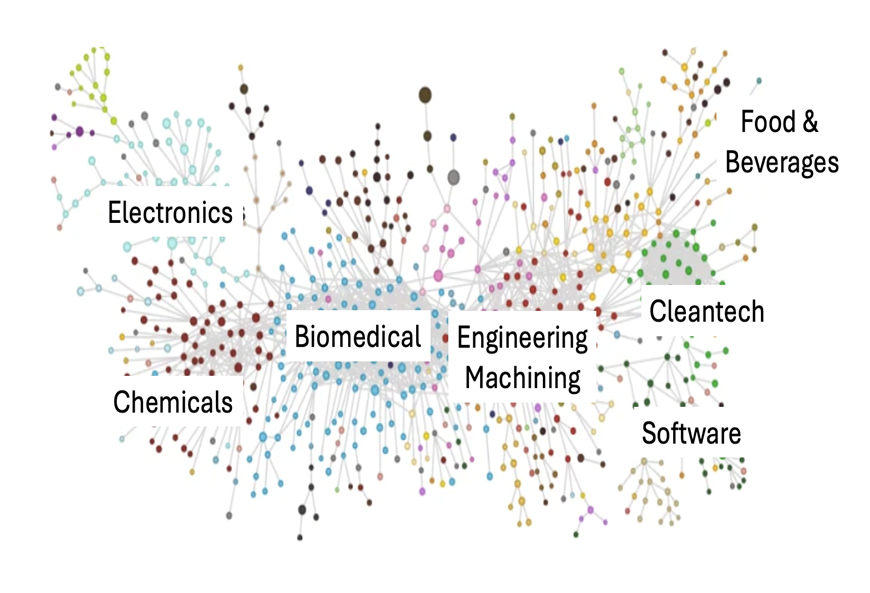
By identifying the products and services offered by the companies in prominent East Bay industries and graphing the products as points, the interconnections are visible. The diagram above shows how biomedical company products often overlap with engineering and machining, electronics, and software. The pharmaceutical companies in the biomedical industry are often on the fringes of the chemical industry. Likewise, cleantech companies are intertwined with engineering and machining, software, and even food and beverage companies.
Indeed, Think Surgical, a Fremont-based surgical robotics company, is in the biomedical industry and relies on the interlinkages of the region. Its technology was originally spun out of a nearby university lab and it relies on electronics, engineering/machining, contract manufacturing, and even software from local sources. Here within lies the strength and resilience of the East Bay economy. Yes, it is more difficult to categorize and map companies in the East Bay, but the robust interlinkages and networks support innovation, entrepreneurship, scale-up, and economic development.
>> Explore the East Bay’s vast network of manufacturing companies and regional assets here.
Special acknowledgements to Dr. Gregory Theyel, Director of the Biomedical Manufacturing Network, for contributing to this feature.