

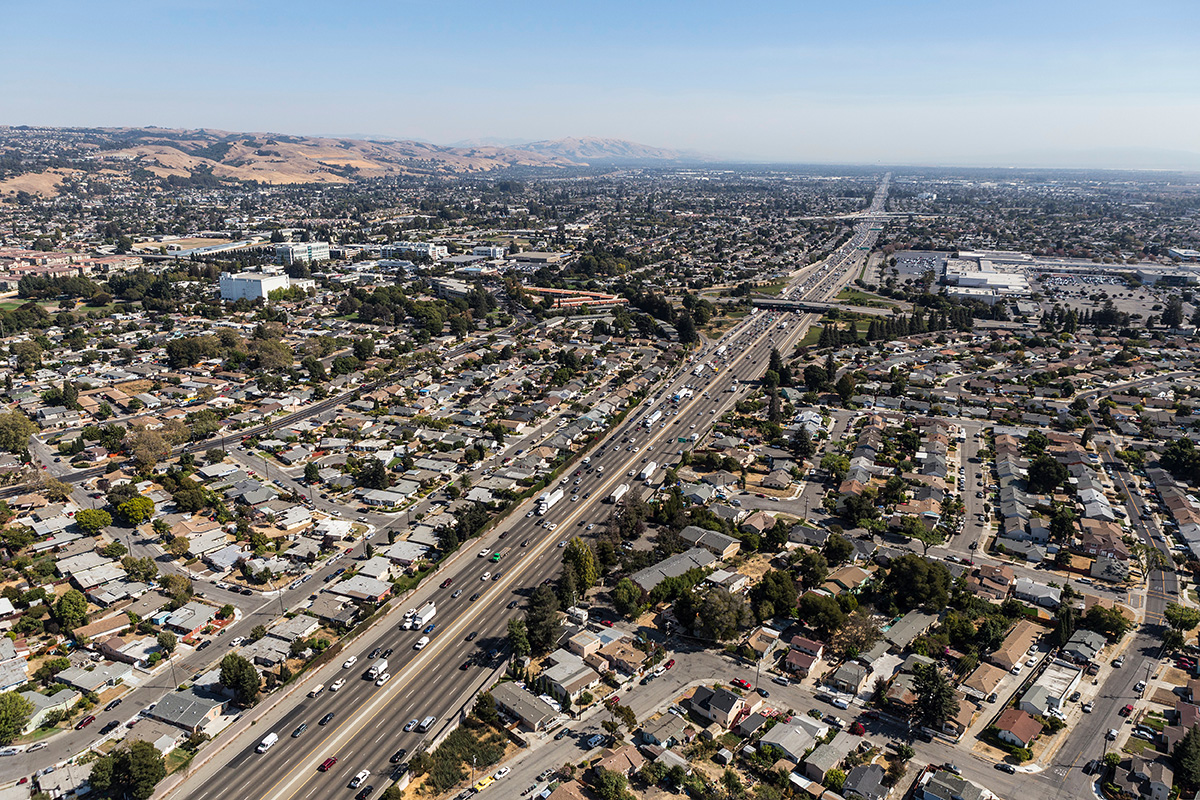
Q: What do you get when you take the Tri-Cities (Newark, Union City, and Fremont), add San Leandro and Hayward, and link them to Silicon Valley?
A: The Southern Alameda County Manufacturing Corridor powerhouse.
The I-880 freeway connects the major cities of Fremont, Newark, Union City, Hayward, San Leandro, and Oakland along the East Bay shoreline, forming one of the state’s most important supply chains and labor markets, powering innovation technologies emerging from Silicon Valley. These cities have a dense employment base, with 60,000 industrial jobs—representing roughly one in five jobs in the corridor—and 71.1 million square feet of industrial space.
Demand for manufacturing suppliers is driven by proximity to Silicon Valley’s innovation, research, and development, as well as the ability to co-locate with customers and partners. These companies include both large Original Equipment Manufacturers (OEMs) and tech firms that design not only software, but also physical products and infrastructure. While these firms lead in design and engineering, they rely on a network of regional suppliers to produce the components and assemblies that bring products to life through prototyping and/or pilot lines—creating middle-skill jobs such as technicians, CNC operators, and maintenance mechanics.
Silicon Valley and the East Bay together support more than 120,000 manufacturing jobs (2024) across Santa Clara and Alameda counties, reflecting a deeply integrated regional system where product design, engineering, and production are closely linked (Source: U.S. Bureau of Labor Statistics QCEW 2024). This concentration of R&D and product development drives demand for component manufacturing, precision machining, electronics assembly, and production scaling, much of which occurs in southern Alameda County along the I-880 corridor.
Local manufacturers emphasize that proximity is a competitive advantage. As Andrea Foote, President of San Leandro-based supplier Scandic, explained:
“Being located close to [the large OEMs/tech companies] is key during product design and prototyping phases of a project. Engineers are able to visit the plant easily, and Scandic can supply multiple iterations of prototypes quickly. When there is an issue with an overseas supplier Scandic can respond quickly to rework parts or supply new ones.”
Even as production may scale outside the region, relationships often remain local:
“A lot of companies have their headquarters here and we have longstanding relationships with their purchasing and supply chain teams, so even if large-scale fabrication happens elsewhere, we sometimes retain the client after the product moves out of prototype.”
These relationships are further reinforced by the region’s dense engineering talent network:
“In Silicon Valley, engineers move between companies throughout their careers…. We’ve seen that some engineers who toured our facility when they were students reach out to us years later to be a supplier for their companies.”
Together, these dynamics create a highly interconnected supply chain ecosystem in which OEMs and tech companies drive demand, and manufacturing suppliers translate that demand into production. In turn, suppliers generate strong demand for local skilled talent across machining, assembly, maintenance, quality, and technical roles. Because many supplier firms operate on smaller margins, they prioritize skills-based hiring and on-the-job training, making middle-skill talent pipelines critical to sustaining operations.
At the recent San Francisco Business Times I-880 Corridors of Opportunity event, featuring regional manufacturers, companies identified supply chain constraints as a primary barrier to scaling and vertical integration. At the same time, the nature of manufacturing work is evolving, increasing the complexity of some roles but not eliminating humans. In modern “smart factory” environments, production processes increasingly rely on real-time data collection for continuous improvement, requiring technicians who can analyze data, build dashboards, and translate insights into operational solutions.
Employers also emphasized the importance of retaining talent locally, noting the need for workers who are committed to building careers in the region rather than leaving the area after putting a “cool” internship on their resume.
Despite strong demand, the pipeline of trained workers remains constrained. Local community colleges, Workforce Development Boards, and training organizations are actively partnering to prepare workers for these middle-skill, living-wage careers. Businesses have the opportunity to partner with these organizations and take advantage of no-cost services and benefits to develop a future talent pipeline. Strengthening these pipelines will support regional economic growth and ensure that companies along the Southern Alameda County Manufacturing Corridor can scale production, reduce supply chain risk, and remain competitive in a high-tech, innovation-driven global market.
Reach out to Claire Michaels at EASTBAYWorks if you’re a business that needs help connecting.