
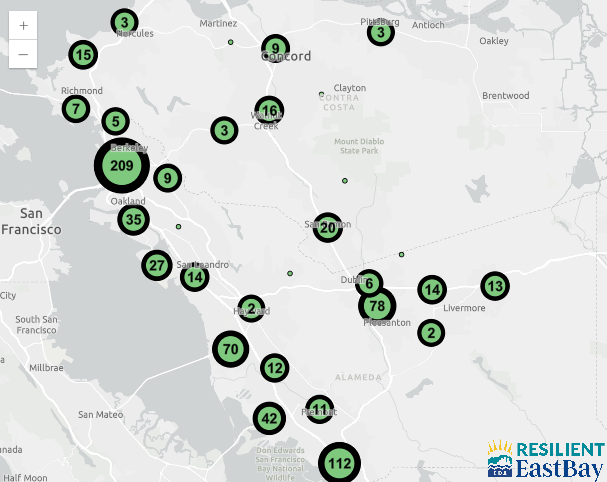
The biomedical industry is a powerhouse industry in the East Bay. Boasting nearly 750 companies developing life-saving drugs, cutting-edge medical devices, and essential healthcare equipment, the region dominates in the life sciences. This eastern subregion of the San Francisco Bay Area is home to a diverse range of businesses, from startups engaged in R&D to manufacturing companies and global corporations. The East Bay biomedical landscape encompasses specialized sub-regions—akin to “microclimates”—each specializing in different stages of the biomedical value chain that makes the broader East Bay dynamic and unique.
Here we’ll explore where these biomedical firms are concentrated, how their locations interconnect, and what drives their growth. From proximity to world-class universities and medical institutions to access to skilled suppliers and supportive policy environments, these microclimates reveal how geography shapes innovation.
Alameda, Berkeley, Emeryville, Oakland: A Hotbed for Biomedical R&D
This East Bay microclimate thrives on early-stage biomedical innovation, with a dense concentration of small R&D-focused firms—many spun out from UC Berkeley and Lawrence Berkeley National Lab. Nearly 290 companies in the Northern Alameda County subregion have direct ties to these institutions, leveraging proximity for talent, collaboration, and research incubation.
While major players like Bayer, Novartis, Abbott, and Exelixis anchor the area, the ecosystem is defined by startups. Entrepreneurs here value incubators, accelerators, flexible lab space, and grant funding. As one executive put it, “UC Berkeley grads see startups as a serious career path.”
The region hosts 10 incubators and accelerators, supported by policies that prioritize early-stage growth, networking, and access to capital. Yet, scaling remains a challenge—firms often relocate once they outgrow the prototype and pilot phase.
Ultimately, this microclimate represents a vibrant convergence of academic spinouts, entrepreneurial energy, and targeted support—a true ecosystem for biomedical germination.
Fremont, Hayward, Newark, and Union City: Scaling Biomedical Innovation
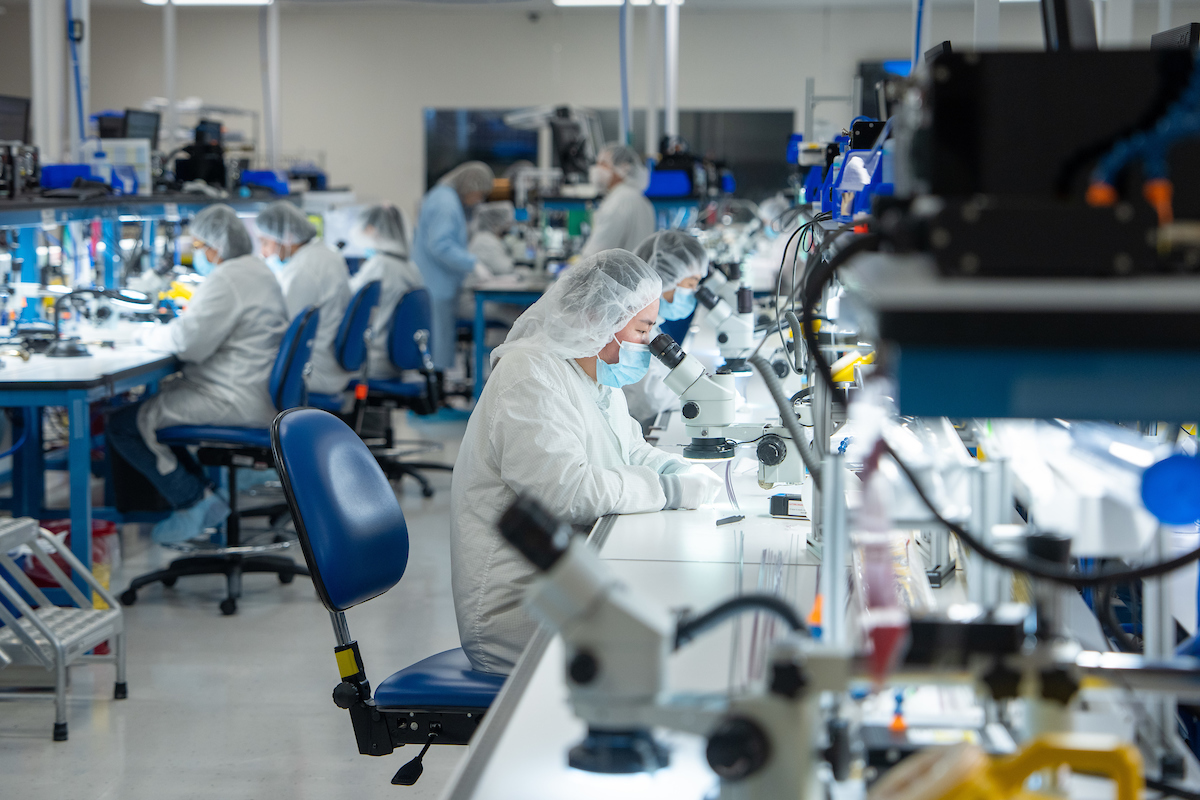
The vast area between Central & Southern Alameda County is where biomedical companies go to grow–over 250 of them. This microclimate is home to larger, more mature firms specializing in biopharmaceuticals and medical device manufacturing. With a manufacturing-ready workforce, streamlined permitting processes, and relatively affordable production space compared to other parts of the Bay Area, it’s built for scale.
Executives describe the area as ideal for transitioning from prototype to full-scale production. Half of new jobs go to workers with high school or associate degrees, making it a key source of middle-wage employment. A strong network of suppliers and skilled labor supports process innovation and supply chain efficiency.
Local policy focuses on practical growth: helping firms secure space, connect with talent, and build supply chain partnerships. As one executive put it, “We outgrew Silicon Valley—Fremont gave us the room and resources to expand.”
This microclimate is defined by scale-up readiness, operational support, and highly-skilled and diverse occupational workforce.
Dublin, Livermore, and Pleasanton: Where Innovation, Talent, and Technology Collide
The Tri-Valley region is home to over 100 biomedical companies. Anchored by industry leaders like Roche, ThermoFisher, Abbott, Zeiss, and 10X Genomics, this microclimate thrives on access to a highly educated workforce drawn from the Highway 680 corridor’s vibrant communities.
Proximity to Lawrence Livermore and Sandia National Labs fuels innovation through spinouts and technology licensing, making Tri-Valley a magnet for firms seeking deep scientific expertise and scalable talent. This microclimate blends suburban appeal with high-tech opportunity—an ideal setting for biomedical growth.
Contra Costa County: A Rising Opportunity for Biomedical Manufacturing
To the north is Contra Costa County, which currently hosts a smaller biomedical footprint—home to around 80 companies. However, this expansive area holds untapped potential as a future hub for industrial-scale production. With extensive heavy industrial and light manufacturing zones already in place, the foundation is set for growth. Anchoring this promise are Bio-Rad, a global leader in medical equipment headquartered in Hercules, and Sangamo Therapeutics, a biotechnology company which recently transitioned its headquarters to Richmond, are serving as models for what’s possible in the county.
As demand for production-ready space and skilled labor continues to rise across the Bay Area, Contra Costa offers a compelling value proposition: ample production facilities and strategic location that can draw from an extensive Northern California workforce. For biomedical firms looking to scale, Contra Costa is poised to become a vital player in the next wave of life sciences expansion.
Despite some recent turbulence in the biomedical industry as it relates to funding and fierce market pressures like drug pricing, tariffs, and high regulatory conditions impacting how companies operate and expand, the East Bay remains a top-tier location for biomedical companies. In summary, the East Bay’s biomedical strength stems from a dynamic and resilient mix of assets:
- Established clusters: The success of early anchor companies like Bayer, ThermoFisher, Boehringer-Ingelheim, and Novartis has helped create vibrant microclimates that attract other companies and talent.
- Manufacturing capability: The East Bay has a strong and growing manufacturing base, with many engineering, machining, and electronics companies offering design, component, and process support.
- Access to talent and research: The region’s top-tier universities, such as UC Berkeley, and its robust venture capital environment feed a steady stream of innovation and talent. Cal State University-East Bay and access to the 28 Bay Area Community Colleges provides capable and locally available talent, especially for a wide range of manufacturing-related occupations.
- Infrastructure: The availability of industrial lands, extensive physical infrastructure such as public transit, highways and ports, as well as supportive local economic development conditions make the region attractive for scaling operations.
- Specialized real estate: Purpose-built lab and cleanroom facilities enable biomedical companies to grow beyond standard office of industrial set ups. The cost and availability of this specific type of real estate has heavily influenced the growth of biomedical companies in the East Bay.
- Bay Area ecosystem: The East Bay operates within the broader San Francisco Bay Area life sciences ecosystem, which includes other major hubs like South San Francisco and the Peninsula. Companies can draw on the region’s extensive talent pool, research infrastructure, and access to capital, and scaling biomedical companies frequently move from other parts of the Bay Area to the East Bay.
Special acknowledgements to Dr. Gregory Theyel, Director of the Biomedical Manufacturing Network, for contributing to this feature.